
SQLite Exercise: Get the department ID and the total salary payable in each department
Write a query to get the department ID and the total salary payable in each department.
Sample table : employees
+-------------+-------------+-------------+----------+--------------------+------------+------------+----------+----------------+------------+---------------+
| EMPLOYEE_ID | FIRST_NAME  | LAST_NAME   | EMAIL    | PHONE_NUMBER       | HIRE_DATE  | JOB_ID     | SALARY   | COMMISSION_PCT | MANAGER_ID | DEPARTMENT_ID |
+-------------+-------------+-------------+----------+--------------------+------------+------------+----------+----------------+------------+---------------+
|         100 | Steven      | King        | SKING    | 515.123.4567       | 1987-06-17 | AD_PRES    | 24000.00 |           0.00 |          0 | 		  90 |
|         101 | Neena       | Kochhar     | NKOCHHAR | 515.123.4568       | 1987-06-18 | AD_VP      | 17000.00 |           0.00 |        100 |            90 |
|         102 | Lex         | De Haan     | LDEHAAN  | 515.123.4569       | 1987-06-19 | AD_VP      | 17000.00 |           0.00 |        100 |            90 |
|         103 | Alexander   | Hunold      | AHUNOLD  | 590.423.4567       | 1987-06-20 | IT_PROG    |  9000.00 |           0.00 |        102 |            60 |
|         104 | Bruce       | Ernst       | BERNST   | 590.423.4568       | 1987-06-21 | IT_PROG    |  6000.00 |           0.00 |        103 |            60 |
|         105 | David       | Austin      | DAUSTIN  | 590.423.4569       | 1987-06-22 | IT_PROG    |  4800.00 |           0.00 |        103 |            60 |
|         106 | Valli       | Pataballa   | VPATABAL | 590.423.4560       | 1987-06-23 | IT_PROG    |  4800.00 |           0.00 |        103 |            60 |
|         107 | Diana       | Lorentz     | DLORENTZ | 590.423.5567       | 1987-06-24 | IT_PROG    |  4200.00 |           0.00 |        103 |            60 |
|         108 | Nancy       | Greenberg   | NGREENBE | 515.124.4569       | 1987-06-25 | FI_MGR     | 12000.00 |           0.00 |        101 |           100 |
|         109 | Daniel      | Faviet      | DFAVIET  | 515.124.4169       | 1987-06-26 | FI_ACCOUNT |  9000.00 |           0.00 |        108 |           100 |
...........
|         206 | William     | Gietz       | WGIETZ   | 515.123.8181       | 1987-10-01 | AC_ACCOUNT |  8300.00 |           0.00 |        205 |           110 |
+-------------+-------------+-------------+----------+--------------------+------------+------------+----------+----------------+------------+---------------+
SQLite Code:
-- Selecting the "department_id" and the sum of salaries for each department
SELECT department_id, SUM(salary)
-- Specifying the table from which to retrieve the data, in this case, "employees"
FROM employees
-- Grouping the results by the "department_id" column
GROUP BY department_id;
Output:
department_id  SUM(sa
-------------  ------
10             4400
20             19000
30             24900
40             6500
50             156400
60             28800
70             10000
80             304500
90             58000
100            51600
110            20300
               7000
Explanation:
The above SQLite query retrieves the "department_id" and the sum of salaries for each department from the "employees" table. The GROUP BY clause is essential for aggregating the sum of salaries for each distinct department.
Here's a brief explanation of each part of SQLite code:
- SELECT clause:
- It selects the "department_id" and the sum of salaries for each department.
- FROM clause:
- Specifies the table from which to retrieve the data, in this case, the "employees" table.
- GROUP BY clause:
- Groups the results by the "department_id" column. This means that the sum of salaries is calculated separately for each unique department.
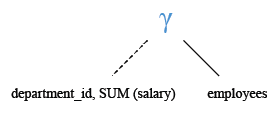
Relational Algebra Expression:

Relational Algebra Tree:
Go to:
PREV : Write a query to find the manager ID and the salary of the lowest-paid employee for that manager.
NEXT : Write a query to get the average salary for each job ID excluding programmer.
Practice SQLite Online
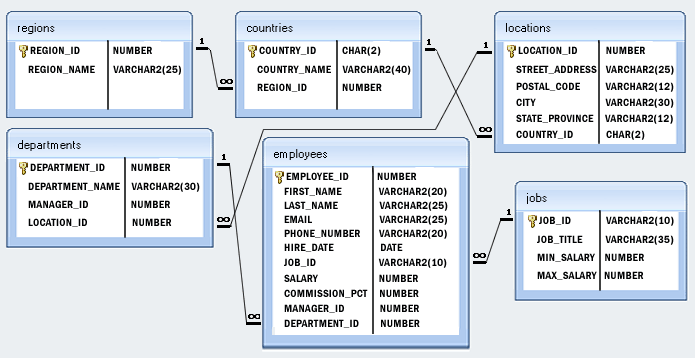
Model Database
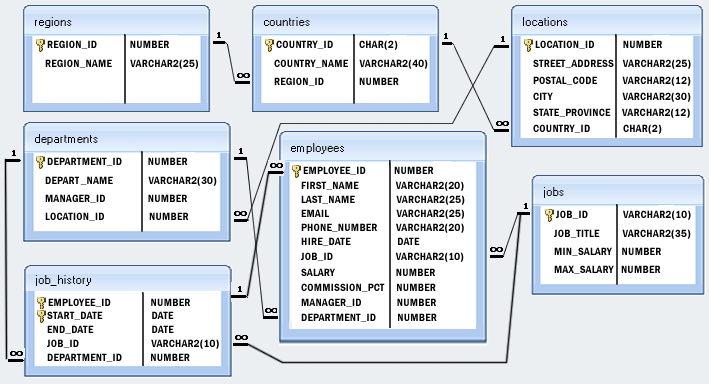
Structure of 'hr' database :
Improve this sample solution and post your code through Disqus.
What is the difficulty level of this exercise?