
SQL Exercises: View to show average and total orders for each salesman
11. From the following table, create a view to compute the average purchase amount and total purchase amount for each salesperson. Return name, average purchase and total purchase amount. (Assume all names are unique.).
Sample table: Salesman
 salesman_id |    name    |   city   | commission
-------------+------------+----------+------------
        5001 | James Hoog | New York |       0.15
        5002 | Nail Knite | Paris    |       0.13
        5005 | Pit Alex   | London   |       0.11
        5006 | Mc Lyon    | Paris    |       0.14
        5007 | Paul Adam  | Rome     |       0.13
        5003 | Lauson Hen | San Jose |       0.12
Sample table: orders
ord_no      purch_amt   ord_date    customer_id  salesman_id
----------  ----------  ----------  -----------  -----------
70001       150.5       2012-10-05  3005         5002
70009       270.65      2012-09-10  3001         5005
70002       65.26       2012-10-05  3002         5001
70004       110.5       2012-08-17  3009         5003
70007       948.5       2012-09-10  3005         5002
70005       2400.6      2012-07-27  3007         5001
70008       5760        2012-09-10  3002         5001
70010       1983.43     2012-10-10  3004         5006
70003       2480.4      2012-10-10  3009         5003
70012       250.45      2012-06-27  3008         5002
70011       75.29       2012-08-17  3003         5007
70013       3045.6      2012-04-25  3002         5001
Sample Solution:
-- Creating a VIEW named 'norders'
CREATE VIEW norders

-- Selecting 'name', average of 'purch_amt', and sum of 'purch_amt' for each salesman
-- Joining the 'salesman' and 'orders' tables on 'salesman_id'
-- Grouping the results by 'name'
AS SELECT name, AVG(purch_amt), SUM(purch_amt)
FROM salesman, orders
WHERE salesman.salesman_id = orders.salesman_id
GROUP BY name;
output:
sqlpractice=# SELECT *
sqlpractice-# FROM norders;
     name     |          avg          |   sum
--------------+-----------------------+----------
 Mc Lyon      | 1152.7150000000000000 |  2305.43
 James Hoog   | 2817.8650000000000000 | 11271.46
 Pit Alex     |  270.6500000000000000 |   270.65
 Lauson Hense | 1295.4500000000000000 |  2590.90
 Paul Adam    |   87.6450000000000000 |   175.29
 Nail Knite   |  466.3166666666666667 |  1398.95
(6 rows)
Code Explanation:
The above statement in SQL creates a view called norders that calculates the average and total purchase amounts for each salesman and returns the results in the columns are name, AVG(purch_amt), and SUM(purch_amt).
The JOIN clause joins the salesman and orders tables on the salesman_id column. The results are grouped by the name column.
Go to:
PREV : View that shows the number of salesman in each city.
NEXT : View to shows each salesman has more than one customer..
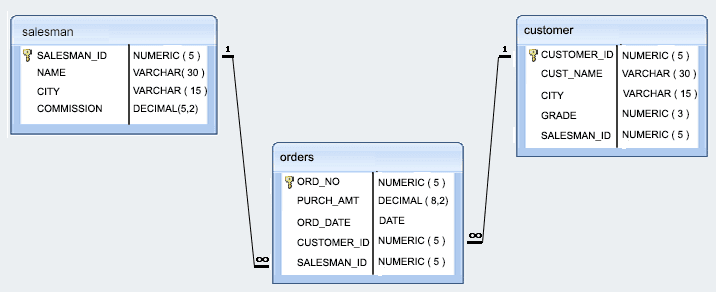
Inventory database model:
Contribute your code and comments through Disqus.
What is the difficulty level of this exercise?
Test your Programming skills with w3resource's quiz.