
SQL Exercise: Find the match in which Germany played against Poland
4. From the following tables, write a SQL query to find the match number in which Germany played against Poland. Group the result set on match number. Return match number.
Sample table: match_details
 match_no | play_stage | team_id | win_lose | decided_by | goal_score | penalty_score | ass_ref | player_gk
----------+------------+---------+----------+------------+------------+---------------+---------+-----------
        1 | G          |    1207 | W        | N          |          2 |               |   80016 |    160140
        1 | G          |    1216 | L        | N          |          1 |               |   80020 |    160348
        2 | G          |    1201 | L        | N          |          0 |               |   80003 |    160001
        2 | G          |    1221 | W        | N          |          1 |               |   80023 |    160463
        3 | G          |    1224 | W        | N          |          2 |               |   80031 |    160532
        3 | G          |    1218 | L        | N          |          1 |               |   80025 |    160392
        4 | G          |    1206 | D        | N          |          1 |               |   80008 |    160117
        4 | G          |    1217 | D        | N          |          1 |               |   80019 |    160369
        5 | G          |    1222 | L        | N          |          0 |               |   80011 |    160486
.......
       51 | F          |    1207 | L        | N          |          0 |               |   80007 |    160140
Sample table: soccer_country
 country_id | country_abbr |    country_name
------------+--------------+---------------------
       1201 | ALB          | Albania
       1202 | AUT          | Austria
       1203 | BEL          | Belgium
       1204 | CRO          | Croatia
       1205 | CZE          | Czech Republic
       1206 | ENG          | England
       1207 | FRA          | France
       1208 | GER          | Germany
       1209 | HUN          | Hungary
.......
       1229 | NOR          | Norway
Sample Solution:
SQL Code:
-- This SQL query retrieves match numbers from the 'match_details' table
-- where the teams are either Germany or Poland, and each match involves both teams.

SELECT match_no
-- Selects the 'match_no' column.
FROM match_details
-- 'match_details' is the name of the table being queried.
WHERE team_id = (
-- The WHERE clause filters rows where 'team_id' matches the country ID for Germany in the subquery.
    SELECT country_id
    -- The subquery selects the 'country_id' column.
    FROM soccer_country
    -- 'soccer_country' is the name of the table involved in the subquery.
    WHERE country_name = 'Germany'
)
OR team_id = (
-- The OR condition allows for rows where 'team_id' matches the country ID for Poland in the subquery.
    SELECT country_id
    -- The subquery selects the 'country_id' column.
    FROM soccer_country
    -- 'soccer_country' is the name of the table involved in the subquery.
    WHERE country_name = 'Poland'
)
GROUP BY match_no
-- Groups the results by 'match_no'.
HAVING COUNT(DISTINCT team_id) = 2;
-- The HAVING clause filters groups where the count of distinct 'team_id' values is equal to 2.
Sample Output:
 match_no
----------
       18
(1 row)
Code Explanation:
The said query in SQL that selects the match number from the 'match_details' table where either the team_id is Germany's country_id or Poland's country_id and there are two distinct team_ids associated with that match.
The WHERE clause filters the results to only include rows where the "team_id" column is equal to either Germany's country_id or Poland's country_id.
The GROUP BY clause groups the results by the "match_no" column.
The HAVING clause filters the results to only include groups where there are two distinct values of the "team_id" column.
So, this query will return the match numbers for matches where Germany or Poland participated and there were exactly two teams in the match.
Alternative Solutions:
Using JOIN and WHERE:
SELECT md.match_no
FROM match_details md
JOIN soccer_country sc ON md.team_id = sc.country_id
WHERE sc.country_name IN ('Germany', 'Poland')
GROUP BY md.match_no
HAVING COUNT(DISTINCT md.team_id) = 2;
Explanation:
This query joins match_details with soccer_country based on the team_id and country_id relation. It then filters for matches involving Germany or Poland, groups the results by match number, and ensures that both teams are present in the match.
Using EXISTS:
SELECT match_no
FROM match_details md1
WHERE team_id = (
    SELECT country_id
    FROM soccer_country
    WHERE country_name='Germany'
)
AND EXISTS (
    SELECT 1
    FROM match_details md2
    WHERE md2.match_no = md1.match_no
    AND md2.team_id = (
        SELECT country_id
        FROM soccer_country
        WHERE country_name='Poland'
    )
);
Explanation:
This query uses two correlated subqueries to find matches where Germany and Poland both participated.
Using INTERSECT:
SELECT match_no
FROM match_details
WHERE team_id = (
    SELECT country_id
    FROM soccer_country
    WHERE country_name='Germany'
)
INTERSECT
SELECT match_no
FROM match_details
WHERE team_id = (
    SELECT country_id
    FROM soccer_country
    WHERE country_name='Poland'
);
Explanation:
This query uses the INTERSECT operator to find matches that involve both Germany and Poland.
Go to:
PREV : Find which was the highest audience match.
NEXT : Find the match where Portugal played against Hungary.
Practice Online
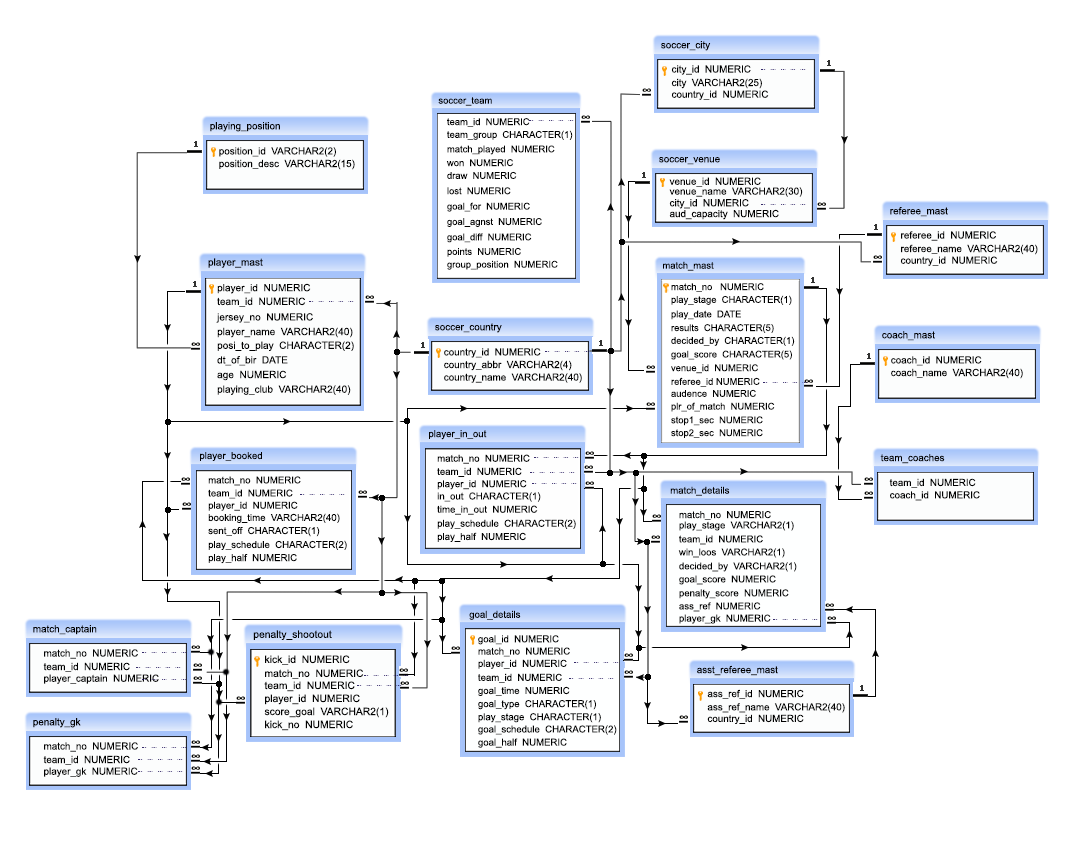
Sample Database: soccer
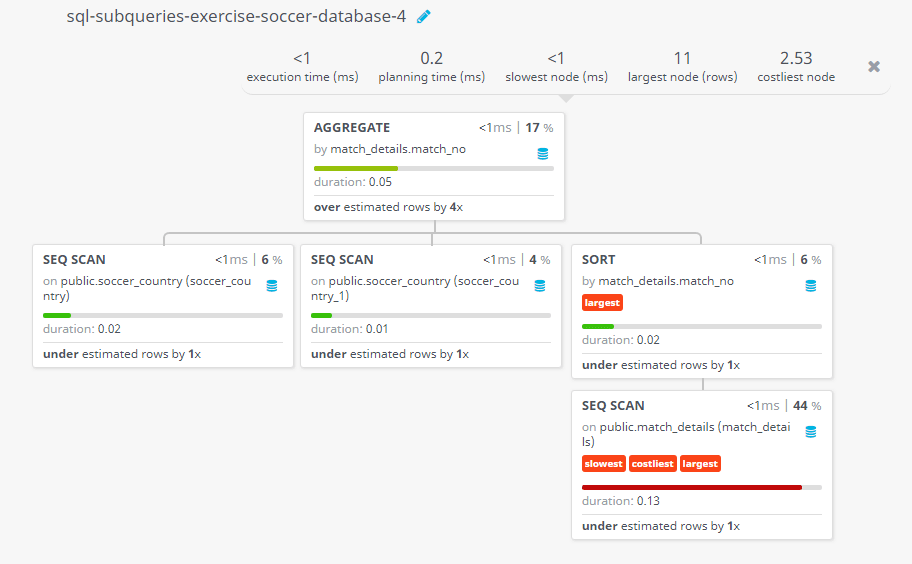
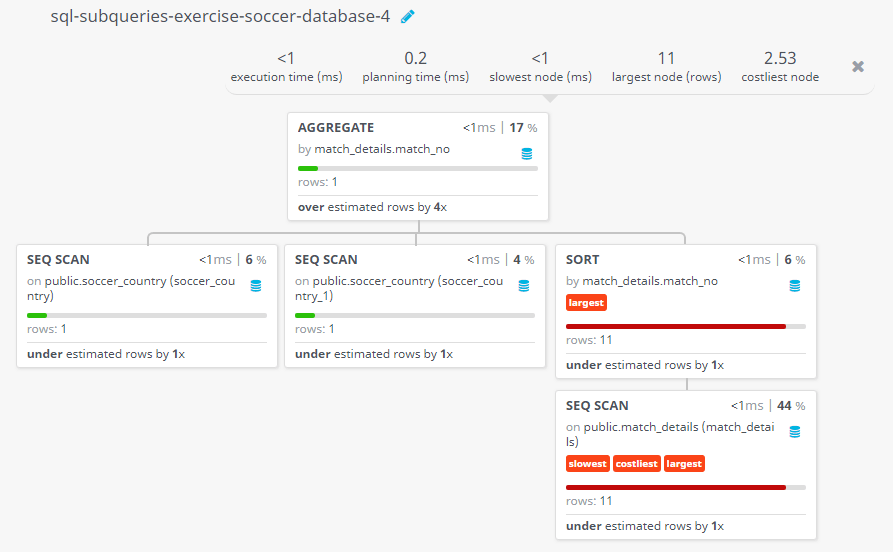
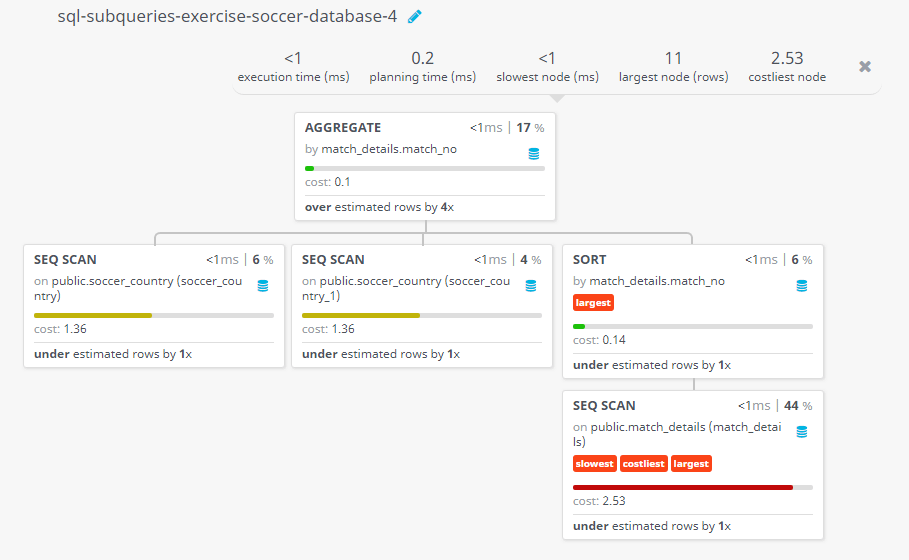
Query Visualization:
Duration:
Rows:
Cost:
//------------- this portion above included on 07-02-2025 ------------------------------ var new_txt = 'Based on '+total_submit+' votes, average difficulty level of this exercise is '+difficulty+'.'; //'. '+difficulty+'/3'; var txt_node = document.createTextNode(new_txt); var level_result = document.getElementById('level_result'); level_result.appendChild(txt_node); } } else { alert('There was a problem with the request.'); } } } } function insert_level(event) { event.preventDefault(); var path = window.location; var page = path.href; var page = page.split('?'); var page = page[0]; //console.log(page); //console.log(page); /*var btns = document.getElementsByClassName("mdl-button mdl-js-button mdl-button--raised mdl-button--colored"); for (var i = 0; i < btns.length; i++) { var clicked = btns[i].id; }*/ var clicked = this.id; if(clicked=="easy") clicked=1; if(clicked=="medium") clicked=2; if(clicked=="hard") clicked=3; console.log(clicked); var httpRequest1 = new XMLHttpRequest(); if (!httpRequest1) { alert('Giving up :( Cannot create an XMLHTTP instance'); //return false; } var url = "/assets/level_insert.php"; var data1 = "level=" + clicked + "&page=" + page; httpRequest1.onreadystatechange = displayContent1; httpRequest1.open("POST", url, true); httpRequest1.setRequestHeader("Content-Type", "application/x-www-form-urlencoded"); httpRequest1.send(data1); console.log(data1); //console.log("found"); function displayContent1(responseText) { if (httpRequest1.readyState === XMLHttpRequest.DONE) { if (httpRequest1.status === 200) { var op = httpRequest1.responseText; console.log(op); } else { alert('There was a problem with the request.'); } } } } var easy = document.getElementById("easy"); easy.addEventListener('click', insert_level, false); var medium = document.getElementById("medium"); medium.addEventListener('click', insert_level, false); var hard = document.getElementById("hard"); hard.addEventListener('click', insert_level, false);
Test your Programming skills with w3resource's quiz.