
MySQL Subquery Exercises: Query to get nth maximum salaries of employees
MySQL Subquery: Exercise-22 with Solution
Write a MySQL query to get nth maximum salaries of employees.
Sample table: employees
+-------------+-------------+-------------+----------+--------------------+------------+------------+----------+----------------+------------+---------------+
| EMPLOYEE_ID | FIRST_NAME  | LAST_NAME   | EMAIL    | PHONE_NUMBER       | HIRE_DATE  | JOB_ID     | SALARY   | COMMISSION_PCT | MANAGER_ID | DEPARTMENT_ID |
+-------------+-------------+-------------+----------+--------------------+------------+------------+----------+----------------+------------+---------------+
|         100 | Steven      | King        | SKING    | 515.123.4567       | 1987-06-17 | AD_PRES    | 24000.00 |           0.00 |          0 |   		  90 |
|         101 | Neena       | Kochhar     | NKOCHHAR | 515.123.4568       | 1987-06-18 | AD_VP      | 17000.00 |           0.00 |        100 |            90 |
|         102 | Lex         | De Haan     | LDEHAAN  | 515.123.4569       | 1987-06-19 | AD_VP      | 17000.00 |           0.00 |        100 |            90 |
|         103 | Alexander   | Hunold      | AHUNOLD  | 590.423.4567       | 1987-06-20 | IT_PROG    |  9000.00 |           0.00 |        102 |            60 |
|         104 | Bruce       | Ernst       | BERNST   | 590.423.4568       | 1987-06-21 | IT_PROG    |  6000.00 |           0.00 |        103 |            60 |
|         105 | David       | Austin      | DAUSTIN  | 590.423.4569       | 1987-06-22 | IT_PROG    |  4800.00 |           0.00 |        103 |            60 |
|         106 | Valli       | Pataballa   | VPATABAL | 590.423.4560       | 1987-06-23 | IT_PROG    |  4800.00 |           0.00 |        103 |            60 |
|         107 | Diana       | Lorentz     | DLORENTZ | 590.423.5567       | 1987-06-24 | IT_PROG    |  4200.00 |           0.00 |        103 |            60 |
|         108 | Nancy       | Greenberg   | NGREENBE | 515.124.4569       | 1987-06-25 | FI_MGR     | 12000.00 |           0.00 |        101 |           100 |
.........
|         206 | William     | Gietz       | WGIETZ   | 515.123.8181       | 1987-10-01 | AC_ACCOUNT |  8300.00 |           0.00 |        205 |           110 |
+-------------+-------------+-------------+----------+--------------------+------------+------------+----------+----------------+------------+---------------+
Code:
-- Selecting all columns from the employees table, aliasing it as 'emp1'
SELECT *
-- Selecting data from the employees table, aliasing it as 'emp1'
FROM employees emp1
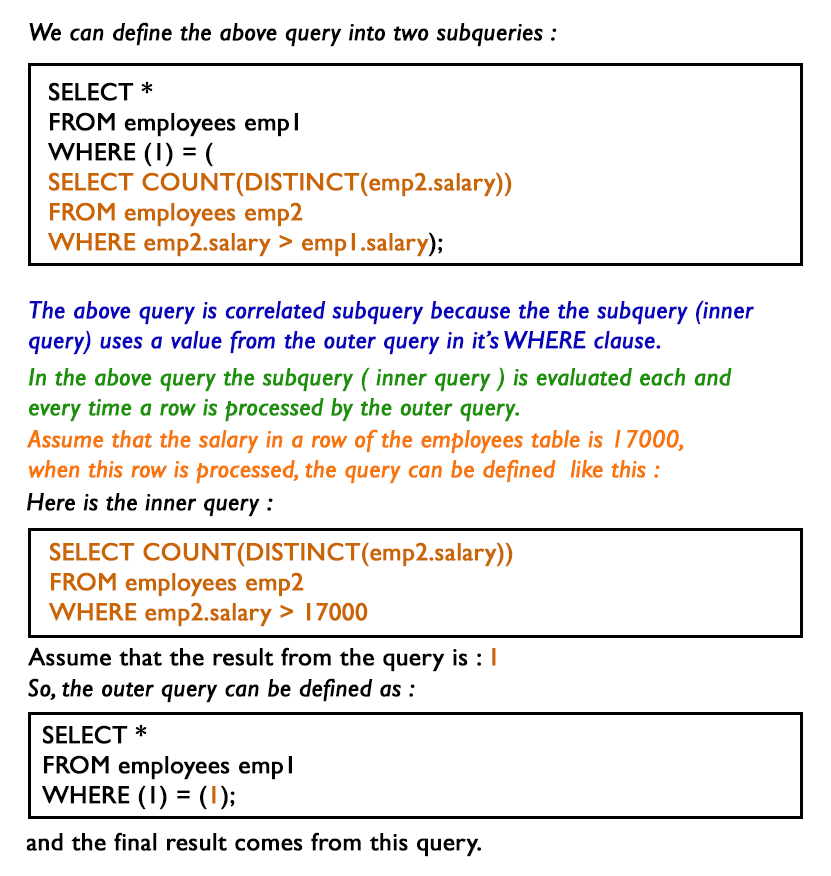
-- Filtering the result set to include only employees where the count of distinct salaries greater than the salary of the current employee is 1
WHERE (1) = (
    -- Subquery to count the number of distinct salaries greater than the salary of each employee
    SELECT COUNT(DISTINCT(emp2.salary))
    -- Selecting data from the employees table, aliasing it as 'emp2'
    FROM employees emp2
    -- Filtering the result set to include only distinct salaries greater than the salary of the employee in the outer query (emp1.salary)
    WHERE emp2.salary > emp1.salary
);
Explanation:
- This MySQL code selects all columns from the "employees" table and aliases it as 'emp1'.
- It filters the result set to include only employees where the count of distinct salaries greater than the salary of the current employee is 1.
- This is achieved using a subquery where the number of distinct salaries greater than the salary of each employee is counted. The outer query compares this count with the constant value 1.
- If there's exactly one distinct salary greater than the salary of an employee, that employee will be included in the result set.
MySQL Subquery Syntax:
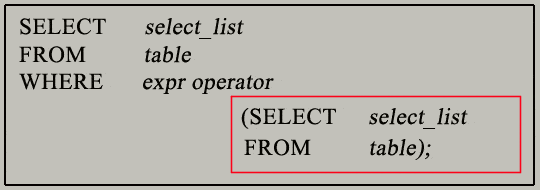
- The subquery (inner query) executes once before the main query (outer query) executes.
- The main query (outer query) use the subquery result.
Go to:
PREV :Write a MySQL query to get 3 minimum salaries.
NEXT :MySQL Joins
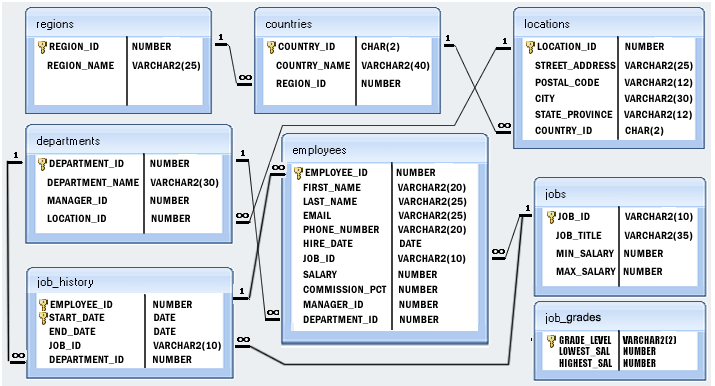
Structure of 'hr' database :
MySQL Code Editor:
Have another way to solve this solution? Contribute your code (and comments) through Disqus.
What is the difficulty level of this exercise?